
Neck Strengthening for Sport and Neck Pain: What Does the Research Say?
By Lachlan Gillies | Physiotherapist & Director of Rebuild Physio Glenelg
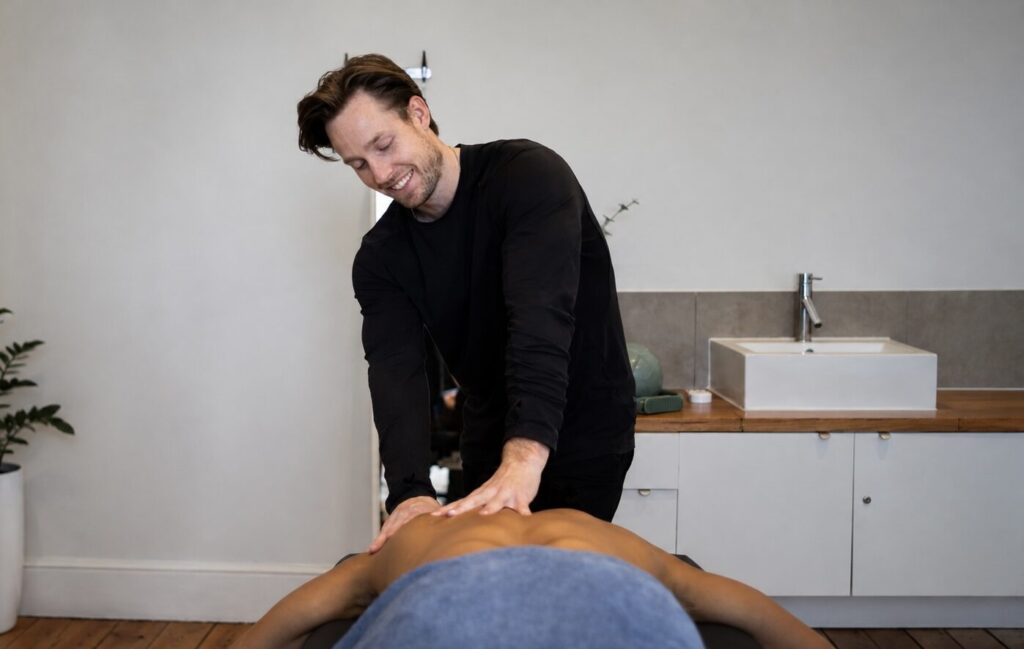
Neck strengthening is an area I have had a particular interest in throughout my physiotherapy career.
I have been involved in published research examining neck strength, neck-strengthening exercise and head and neck injuries, including concussion, in rugby athletes.
This research has helped shape the way I think about neck rehabilitation clinically.
While an elite rugby player and someone experiencing everyday neck pain are very different, there is an important principle that can apply across both settings:
The neck is a physical structure that can be progressively strengthened and conditioned.
For people experiencing neck pain, recovering from a neck injury, returning to the gym or preparing for the demands of sport, improving physical capacity can therefore be an important part of rehabilitation.
Why is neck strength important?
The neck has to perform several jobs at once.
It needs to provide enough mobility to allow us to comfortably move our head, while also providing muscular control and strength to manage the physical demands placed upon it.
Those demands vary enormously between people.
For an office worker, that might mean tolerating prolonged periods at a desk. For someone who trains in the gym, it may involve heavy lifting. For an athlete, it could involve running, rapid movement, contact or collision.
In rugby and other contact sports, the demands can be particularly high. Players may experience substantial forces during tackling, collisions, scrums and other contact situations.
This has led researchers to investigate whether characteristics such as neck strength and muscular balance may have a relationship with head and neck injury.
It is also one of the reasons I became interested in researching the area.
What did our neck-strength research investigate?
One of the studies I led examined the implementation of a neck-strengthening exercise program within an elite rugby union team.
The program targeted several directions of neck strength, including:
- neck flexion
- neck extension
- lateral flexion
- rotation
We examined head and neck injuries during the season in which the strengthening program was implemented and compared these with injury data from the previous season.
We also investigated measures of neck strength, including the relationship between neck flexor and extensor strength.
This is often described as the flexion-to-extension ratio, or F/E ratio.
Rather than simply asking whether someone had a “strong neck,” this allowed us to investigate whether the relationship between different directions of neck strength might also be relevant.
What happened after the neck-strengthening program?
There were some interesting findings.
Following implementation of the neck-strengthening program, the observed concussion rate was lower compared with the previous season.
Among forwards, there were 45% fewer concussions and 17% fewer head and neck injuries.
Among backs, there were 25% fewer concussions and 11% fewer head and neck injuries.
These results are interesting, but they need to be interpreted appropriately.
This was a single-team case study conducted across two seasons, rather than a large randomised controlled trial. There are many factors that can influence injury rates from one season to another.
For that reason, our research cannot establish that the neck-strengthening program caused the reduction in injuries or concussions.
Instead, the findings provide an interesting basis for further investigation into neck strength and physical preparation in contact-sport athletes.
Neck strength isn’t just about having a “strong neck”
One of the most interesting aspects of our research was the relationship between neck flexor and extensor strength.
We found that a lower flexion-to-extension strength ratio was associated with a greater history of previous head and neck injuries, including concussion.
During the season we observed, every head and neck injury, including concussion, occurred in a player who had started the program with an F/E ratio below 0.60.
That does not mean that 0.60 is a magic number or that a ratio below this level predicts that someone will sustain a concussion.
Our study wasn’t designed to establish a clinical cut-off like that.
However, the finding was interesting because it suggested that looking only at absolute strength may not tell the entire story. The relationship between different muscle groups may also warrant further investigation.
This question was explored further in research I co-authored examining neck strength and concussion prevalence in football and rugby athletes, where a lower flexion-to-extension ratio was also associated with previous concussion history.
Can strengthening your neck prevent concussion?
This is where it is particularly important to be careful with the research.
We cannot currently say that strengthening your neck will prevent concussion.
However, there are some promising findings.
A systematic review examining injury-reduction programs for sport-related head and neck injuries found that programs incorporating neck-strengthening exercises were associated with reductions in head and neck injuries, including concussion.
This is encouraging, but it does not prove that neck strengthening alone prevents concussion. Concussion is a complex sporting injury, and risk is influenced by many factors. Appropriate rules, technique, coaching, medical assessment and concussion-management protocols remain extremely important.
Research continues to investigate whether greater neck strength and targeted neck-strengthening programs may reduce concussion risk, but the overall evidence is not yet definitive.
What we can say with confidence is that neck strength is trainable.
For athletes exposed to substantial head and neck demands, appropriately developing neck strength may therefore be a useful component of a broader physical-preparation and injury-reduction program.
But what does this research mean for someone who isn’t an elite athlete and simply has neck pain?
Most people I see for neck pain aren’t elite rugby players.
They might have developed neck pain associated with work, experienced a flare-up after training, sustained a sporting injury, or simply found that their neck is stopping them from doing the things they want to do.
So I don’t take an elite rugby strengthening program and simply prescribe it to everyone with neck pain.
The research instead reinforces a broader principle that influences my approach to rehabilitation:
We should think about what the neck needs to be capable of doing.
A physiotherapy assessment may therefore consider factors such as your symptoms, movement, physical capacity, training or occupational demands, injury history and what you ultimately want to return to.
Treatment can then be individualised around those findings.
For some people, symptom-relieving treatment may be useful early in rehabilitation. However, where appropriate, rehabilitation can progress beyond simply reducing pain and towards rebuilding the neck’s ability to tolerate the demands placed upon it.
The goal isn’t just for your neck to feel better while you’re in the treatment room.
The goal is to help you build the capacity to do what you need to do outside of it.
What does neck strengthening actually involve?
There isn’t one perfect neck-strengthening exercise.
Depending on the individual, rehabilitation may involve gradually loading different neck movements and muscle groups, including flexion, extension, lateral flexion and rotation.
The appropriate starting point and progression will depend on the person.
Someone returning to contact sport will have very different physical requirements from someone trying to comfortably work at a computer, return to running or perform heavy strength training.
As rehabilitation progresses, exercises can be modified to provide an appropriate challenge and prepare the individual for their specific goals.
This is one of the reasons I prefer to think about rehabilitation in terms of building capacity, rather than simply treating a painful body part.
Do I need to have my neck strength formally tested?
Not necessarily.
Our research used specific equipment and testing protocols funded by the University of Sydney to quantify neck strength and calculate measures such as the flexion-to-extension ratio.
Rebuild Physio does not currently offer laboratory-style formal F/E ratio testing.
For the majority of people presenting with neck pain, formal strength testing of this kind is not necessary to begin an appropriate rehabilitation program.
A clinical physiotherapy assessment can still examine your symptoms, movement, functional capacity and the activities you’re having difficulty performing.
From there, strengthening can be introduced and progressed where appropriate.
This distinction is important: the equipment and testing methodology used in research should not be confused with a standard clinical assessment.
Should everyone with neck pain strengthen their neck?
Not automatically.
“Neck pain” isn’t a single diagnosis, and there are many different reasons someone may experience symptoms.
That is why assessment comes first.
For the appropriate person, however, progressive strengthening can form part of a broader rehabilitation program.
That doesn’t mean finding the hardest neck exercise online and doing it immediately.
Like other forms of strength training, the starting load, exercise selection and progression should reflect the person’s current capacity and goals.
A rugby player preparing for contact, a recreational runner experiencing neck discomfort and someone whose symptoms are aggravated by desk work shouldn’t necessarily receive the same program.
Neck pain and returning to the gym or sport
This is an area I’m particularly interested in clinically.
People who enjoy training often don’t just want their pain to disappear.
They want to know:
Can I lift again?
Can I run?
Can I return to contact?
How heavy should I go?
What should I change while my neck settles down?
Those questions require more than simply identifying which movements hurt.
Rehabilitation should consider the demands of the activity the person wants to return to and progressively prepare them for those demands.
Manual therapy and other treatment strategies may sometimes help manage symptoms, but for many active people, rehabilitation also needs to address strength, load tolerance and confidence returning to activity.
My research into neck strength has reinforced my interest in this side of neck rehabilitation: not simply settling symptoms, but helping people rebuild physical capacity.
Looking for physiotherapy for neck pain in Glenelg?
If neck pain is affecting your work, gym training, running or sport, an individual physiotherapy assessment can help determine what may be contributing to your symptoms and develop an appropriate rehabilitation plan.
I’m Lachlan Gillies, Physiotherapist and Director of Rebuild Physio Glenelg, with clinical interests in neck rehabilitation, sporting injuries and strength-based rehabilitation.
I have also co-authored peer-reviewed research examining neck strength, neck-strengthening programs and head and neck injuries in rugby athletes.
You can learn more about our approach on our Neck Pain Physiotherapy in Glenelg page.
If you’re dealing with neck pain or want help returning confidently to training or sport, you can book a physiotherapy appointment with me at Rebuild Physio Glenelg.
Book your appointment with Lachlan: https://rebuildphysio.com.au/booking/
About the author
Lachlan Gillies: Physiotherapist & Director, Rebuild Physio Glenelg
Lachlan is a physiotherapist with a particular interest in strength-based rehabilitation, sporting injuries and helping active people return to training.
His published research has investigated neck strength, neck-strengthening exercise and head and neck injuries in rugby athletes.
Research
Gillies L, McKay M, Kertanegara S, Huertas N, Nutt S, Peek K.
The implementation of a neck strengthening exercise program in elite rugby union: A team case study over one season.
Physical Therapy in Sport. 2022;55:248–255.
Nutt S, McKay MJ, Gillies L, Peek K.
Neck strength and concussion prevalence in football and rugby athletes.
Journal of Science and Medicine in Sport. 2022.
Elliott J, Heron N, Versteegh T, Gilchrist IA, Webb M, Archbold P, et al.
Injury Reduction Programs for Reducing the Incidence of Sport-Related Head and Neck Injuries Including Concussion: A Systematic Review.
Sports Medicine. 2021.
