
Hamstring Pain in Runners: Strains, Tendon Pain and Returning to Running
By Lachlan Gillies | Physiotherapist & Founder of Rebuild Physio Glenelg
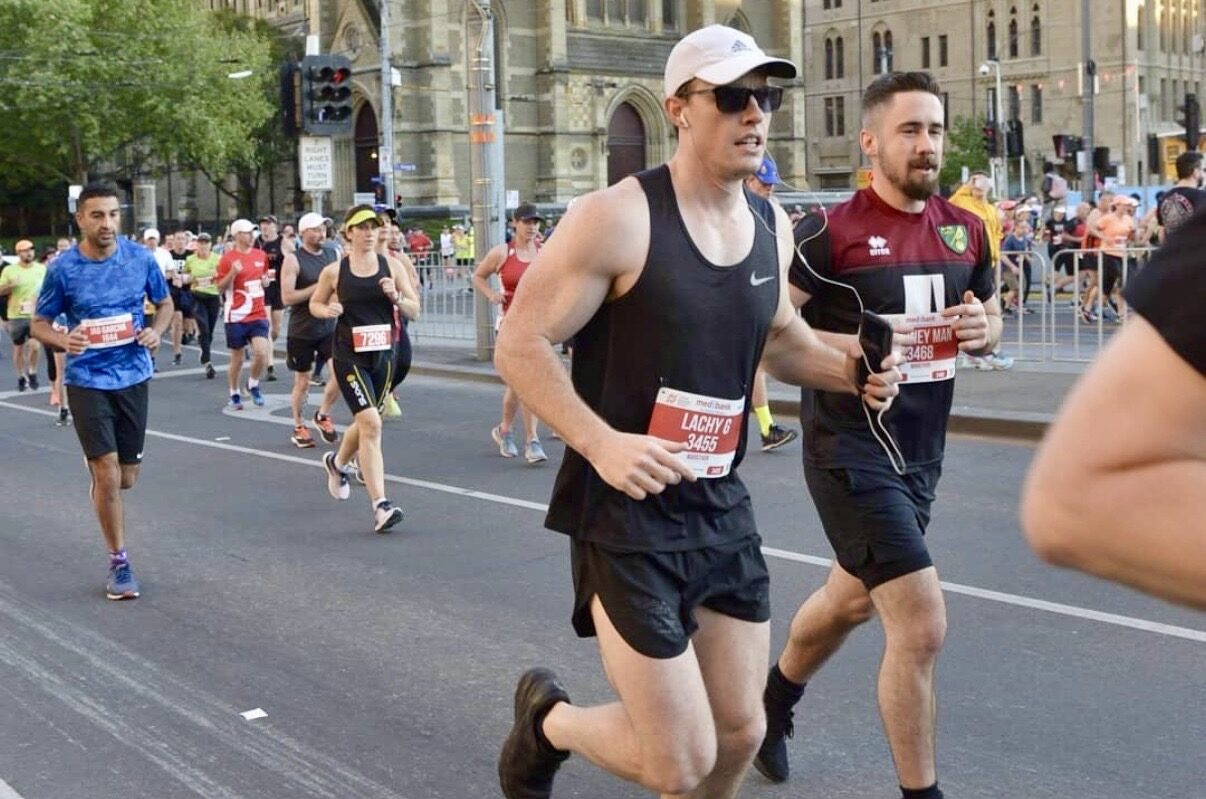
Hamstring pain is a common problem in runners, particularly when training begins to include faster running, sprinting, hills or sudden increases in workload.
Sometimes the cause is obvious. A runner accelerates, sprints or reaches for a longer stride and suddenly feels pain in the back of the thigh.
Other times, hamstring pain develops gradually. The runner may notice tightness during running, pain high underneath the buttock, discomfort when sitting or a hamstring that continually feels tight despite stretching and foam rolling.
These presentations are not necessarily the same problem.
When I assess hamstring pain in a runner, I want to understand what structure is involved, what the hamstring is currently capable of tolerating and what has changed in the runner’s training.
The goal is not simply to settle the pain. It is to rebuild enough capacity for the hamstring to tolerate running again.
Why are hamstring injuries common in runners?
The hamstrings have an important role during running.
They cross both the hip and knee and contribute to controlling the leg as it moves through the running cycle.
As running speed increases, the demands placed on the hamstrings can become substantial. During late swing, just before the foot contacts the ground, the hamstrings are working at relatively long muscle lengths while helping control the rapidly moving leg.
This is one reason high speed running and sprinting are particularly demanding on the hamstrings.
However, hamstring injuries are rarely explained by one factor alone.
Training load, running speed, previous hamstring injury, strength, fatigue, running technique and the runner’s overall physical capacity may all be relevant.
What does a hamstring strain feel like?
An acute hamstring strain will often cause a relatively sudden pain through the back of the thigh.
This may occur during sprinting, accelerating, faster running or another explosive movement.
Symptoms can range considerably depending on the injury.
A runner with a relatively minor strain may be able to continue walking with only mild discomfort. A more significant injury may cause considerable pain, weakness, bruising and difficulty walking normally.
The location matters too.
The hamstrings are a group of muscles rather than a single structure, and injuries can occur at different locations within the muscle and musculotendinous system.
This can influence both rehabilitation and the expected recovery.
Why does my hamstring keep getting injured?
Previous hamstring injury is an important consideration when someone presents with another hamstring problem.
One reason recurrence can occur is that feeling better does not necessarily mean the hamstring has regained everything required for running at full speed.
A runner might be able to walk, perform everyday activities and even jog comfortably while still lacking the strength and capacity required for faster running.
Rehabilitation therefore needs to progress beyond simply becoming pain free.
Later stages should prepare the hamstring for the actual demands the runner intends to return to.
For someone who only runs easily, those demands will be different from those of a footballer, sprinter or runner regularly completing intervals.
Current expert consensus supports individualised rehabilitation based on the injury, the athlete and the demands they need to return to.
Training load matters
One of the first things I look at with a running injury is what has changed.
That might include increases in:
Running volume
Running frequency
Speed sessions
Sprint exposure
Hills
Long runs
Gym training
Overall training intensity
The body adapts to load when it is given an appropriate opportunity to do so.
Problems can develop when the demands of training increase faster than the runner’s current capacity.
This does not mean running is damaging the hamstrings. It means the relationship between load and capacity needs to be considered.
Simply resting until the hamstring feels better without rebuilding its capacity may leave the same problem waiting when training resumes.
Hamstring strength is more than doing one exercise
Strengthening is an important part of hamstring rehabilitation, but there is no single hamstring exercise that every runner needs.
The hamstrings work across both the hip and knee.
For this reason, rehabilitation can include exercises that challenge the hamstrings through different functions, muscle lengths and contraction types.
Depending on the stage of rehabilitation, this may include isometric loading, progressive resistance training and eventually eccentric loading at longer muscle lengths.
Hip dominant and knee dominant exercises can also provide different challenges to the hamstring muscle group.
The important part is not simply choosing a popular exercise.
It is determining what the injured hamstring currently tolerates and what capacity it needs to regain.
Current international consensus supports progressive hamstring loading, including developing eccentric and longer length strength later in rehabilitation, while recognising that the exact progression should be individualised.
What about Nordic hamstring exercises?
Nordic hamstring exercises receive a lot of attention, particularly in sport.
They can be a useful way of developing eccentric knee flexor strength and have an important place in hamstring conditioning.
But doing Nordics alone does not represent complete hamstring rehabilitation.
Running requires the hamstrings to function across the hip and knee, at different muscle lengths and eventually at substantial speeds.
Depending on the runner, rehabilitation may therefore include both hip dominant and knee dominant strengthening before progressing toward more running specific demands.
Does running technique contribute to hamstring pain?
Sometimes.
Running technique should not automatically be blamed whenever someone develops a hamstring injury, and there is no single running style that every runner should use.
However, there are situations where technique may be worth assessing.
One feature I may look at is overstriding, where the foot lands relatively far ahead of the runner’s body.
I may also consider stride length, cadence, trunk position and how the runner moves as speed increases.
A pronounced forward trunk position combined with the movement of the leg may also alter the demands placed on the posterior chain.
These findings need to be interpreted in the context of the individual runner rather than treated as faults that automatically need correcting.
If we think a feature of someone’s running is contributing to their symptoms, a small technique modification may sometimes form part of their rehabilitation.
You can learn more about this in our Running Technique and Running Injuries article.
Pain high underneath the buttock may be different
Not every painful hamstring is a hamstring strain.
Pain close to the sitting bone at the top of the hamstring can sometimes represent proximal hamstring tendinopathy.
This often behaves differently from an acute muscle strain.
Runners may describe pain around the lower buttock or hamstring origin that develops gradually rather than during one obvious incident.
Sitting can become uncomfortable, particularly for longer periods.
Running faster, running uphill, lunging and activities involving greater hip flexion can also aggravate symptoms in some people.
Proximal hamstring tendinopathy can be sensitive to compression at the tendon attachment, which is one reason simply stretching an already painful proximal hamstring is not always helpful.
Assessment usually combines the history with specific loading and pain provocation tests. Progressive loading, education and management of provocative compression are central components of conservative management.
Not all pain at the back of the thigh comes from the hamstring
This is an important part of assessment.
Pain in the hamstring region does not automatically mean the hamstring itself is injured.
Depending on the presentation, we may also consider the lumbar spine and neural structures, particularly when symptoms include radiating pain, altered sensation, pins and needles or other neurological features.
Pain around the upper hamstring and buttock can also have other causes.
This is why repeatedly stretching or strengthening a muscle simply because it feels tight does not always solve the problem.
The diagnosis comes first.
How do we assess hamstring pain in runners?
Assessment starts with understanding what happened.
Was there a sudden injury while sprinting?
Did the pain gradually develop as training increased?
Does sitting aggravate it?
Is it painful during easy running or only at higher speeds?
Does the runner experience symptoms through the lower back or further down the leg?
From there, assessment may consider the location and behaviour of symptoms, strength, range of movement, hamstring loading tolerance and relevant movements.
For runners, I also want to understand their recent training.
When appropriate, running technique can be assessed as well.
This allows us to build a picture of why this particular runner is experiencing hamstring pain, rather than treating every hamstring injury with the same program.
Does manual therapy help hamstring pain?
Hands on treatment can sometimes be useful for symptom management, particularly when surrounding tissues are painful or restricted.
But manual therapy does not replace rehabilitation.
If the hamstring needs to tolerate running again, eventually it needs to be progressively exposed to the forces required for running.
That means rebuilding strength and capacity and then gradually restoring running load.
Returning to running after a hamstring injury
Returning to running is not simply a matter of waiting a certain number of weeks.
Two people with hamstring injuries can have very different rehabilitation timelines.
Progression should consider the type and severity of injury, symptoms, strength, response to loading and the demands of the activity the person wants to return to.
Early running may begin at relatively low speeds when appropriate.
From there, running volume and speed can progressively increase as the hamstring demonstrates that it can tolerate greater demand.
For athletes who need to sprint, exposure to higher speed running becomes an important part of later rehabilitation.
International expert consensus strongly supports running and sprinting as key components of hamstring rehabilitation and recommends criteria based progression rather than relying purely on time.
The exact progression will vary between runners. You can read more about how we determine a starting point and progressively rebuild running load in our guide to returning to running after injury.
Why the treadmill can sometimes be useful
A treadmill can be useful when gradually reintroducing running after injury.
Running mechanics and loading can differ somewhat from overground running, and the controlled environment can make it easier to introduce short, measured bouts of running and monitor symptoms.
However, treadmill running is not automatically easier on every hamstring and should not be considered a way of completely unloading the muscle.
The eventual goal is to prepare the runner for the environment, speed and training they actually want to return to.
Should I stretch a sore hamstring?
It depends on why it is sore.
A sensation of tightness does not necessarily mean the hamstring needs to be stretched.
Following an acute strain, aggressive stretching may be inappropriate early in recovery.
With proximal hamstring tendinopathy, sustained hip flexion can increase compression around the proximal tendon and may aggravate symptoms in some people.
This is another reason identifying the actual problem matters.
The answer to a hamstring that continually feels tight is not always more stretching.
Strengthening the hamstrings for running
As symptoms improve, rehabilitation should progressively resemble what the runner needs their hamstrings to do.
That may involve developing:
Hamstring strength
Strength at longer muscle lengths
Hip extension capacity
Knee flexion strength
Eccentric strength
Pelvic and lower limb control
Fatigue resistance
Running tolerance
Higher speed running capacity where required
For some runners, strength through the glutes, calves and remainder of the lower limb may also form part of the picture.
The goal is to build a runner who can tolerate their training rather than simply producing a stronger hamstring in isolation.
Our Strength Training for Runners article explains this broader approach in more detail.
Physiotherapy for hamstring injuries in Glenelg
At Rebuild Physio Glenelg, we assess hamstring injuries in the context of the person and the activity they want to return to.
For runners, that means looking beyond the painful area.
Depending on your presentation, assessment may include your training history, hamstring strength and capacity, hip and knee function, lumbar and neural involvement and running technique where relevant.
Treatment can then be directed toward the factors that actually matter to you.
The goal is not simply to get the hamstring comfortable enough to jog again.
It is to progressively rebuild the capacity required for the running you want to do.
If hamstring pain is stopping you from running, or keeps returning every time you increase your training, you do not need to determine whether the problem is your strength, training load, running technique, tendon or something else before booking.
That is what the assessment is for.
Book an appointment at Rebuild Physio Glenelg
If a running injury is stopping you from training or performing at your best, our Running Injury Physiotherapy in Glenelg service is designed to help runners understand their injury, rebuild capacity and return to running.
Book a physiotherapy appointment at Rebuild Physio Glenelg and we can assess the problem and develop an individual plan to help you return to running.
About the Author
Lachlan Gillies

Founder, Director and Physiotherapist
Rebuild Physio Glenelg
Lachlan has a particular interest in running injuries, sports physiotherapy and strength-based rehabilitation. As a two-time marathon runner and physiotherapist with a strength and conditioning background, he enjoys helping runners understand their injuries, rebuild their physical capacity and return to running and training.
References
Martin RL, Cibulka MT, Bolgla LA, et al. Hamstring Strain Injury in Athletes: Clinical Practice Guidelines Linked to the International Classification of Functioning, Disability and Health. Journal of Orthopaedic & Sports Physical Therapy. 2022
Hickey JT, Opar DA, Weiss LJ, Heiderscheit BC. Hamstring Strain Injury Rehabilitation. Journal of Athletic Training. 2022
Schache AG, Dorn TW, Blanch PD, Brown NAT, Pandy MG. Mechanics of the Human Hamstring Muscles During Sprinting. Medicine & Science in Sports & Exercise. 2012
Chumanov ES, Schache AG, Heiderscheit BC, Thelen DG. Hamstrings Are Most Susceptible to Injury During the Late Swing Phase of Sprinting. British Journal of Sports Medicine. 2012
Paton BM, Bourne MN, Opar DA, et al. London International Consensus and Delphi Study on Hamstring Injuries Part 3: Rehabilitation, Running and Return to Sport. British Journal of Sports Medicine. 2023
Cushman DM, Rho ME. Comparison of Conservative Interventions for Proximal Hamstring Tendinopathy: A Systematic Review and Recommendations for Rehabilitation. International Journal of Sports Physical Therapy. 2023.
